
WELCOME BONUS 300%
UP TO €2000 + 100
FREE SPINS
UP TO €2000 + 100
FREE SPINS
Home → Roulette
Roulette at neon54
Distribute 500 Euro Bankroll at the Lightning Table
Ultimate Roulette by Ezugi allows wagers from 0,10 EUR up to 5.000 EUR, providing substantial flexibility for high-stakes players managing their funds effectively. The game features multipliers reaching up to 1.000x on up to five numbers, with potential doubling to 2.000x, significantly altering standard payout expectations during live sessions. This structure requires careful bankroll management to withstand volatility while chasing these enhanced multiplier events on the specific table layout.
Quantum Roulette by Playtech offers similar betting limits ranging from 0,10 EUR to 5.000 EUR, utilizing Quantum Multipliers that can reach up to 500x on selected numbers. These multipliers apply to one to five numbers, creating distinct payout opportunities compared to traditional roulette variants without such digital enhancements. Players must adjust their stake sizes accordingly to accommodate the higher variance introduced by these random multiplier applications during gameplay.
The RTP for Ultimate Roulette is 97.30%, matching standard European wheel mathematics despite the added multiplier features influencing short-term outcomes. Straight bets pay 35:1, Split bets 17:1, and Street bets 11:1, maintaining conventional payout ratios across all standard wager types available. This consistency ensures that base payouts remain predictable even when multiplier events occur, allowing for straightforward calculation of expected returns over time.
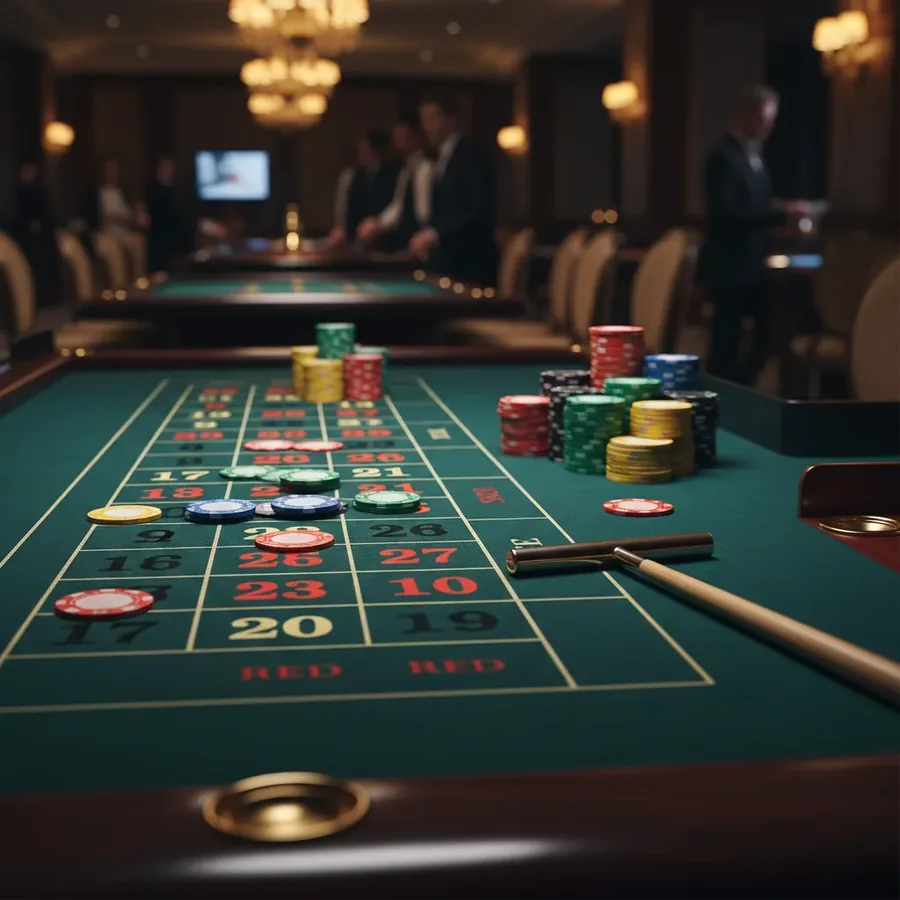
Place Chip Until Rien ne va plus
Roulette Europäisch utilizes a single zero on 37 sectors, resulting in a house edge of 2.70% and an RTP of 97.30% for all bet types. This constant edge applies uniformly to every wager placed, including Straight bets paying 35:1 and Column bets paying 2:1, ensuring mathematical stability. The 'Rien ne va plus' signal marks the end of betting before the ball settles, locking in these fixed probabilities for each spin outcome.
Roulette Französisch inner bets also operate on a 37-sector wheel with a 2.70% house edge, but crucially exclude La Partage rules for internal wagers. While outer bets might benefit from special refund rules, inner bets like Split (17:1) and Corner (8:1) retain the full European disadvantage. This distinction means players face identical risk levels as in standard European versions unless they strictly limit themselves to eligible even-money propositions.
Roulette Amerikanisch introduces a double zero across 38 sectors, increasing the house edge to 5.26% and lowering the overall RTP to 94.74%. This additional sector doubles the disadvantage compared to the single-zero variant, affecting all standard bets such as Dozen (2:1) and Red/Black (1:1). The structural change fundamentally alters long-term retention rates, making this variant significantly less favorable for sustained play strategies.
How Much Bonus Wager for 100 Euro Roulette Bet?
Table games contribute only 10% toward the bonus turnover requirement, meaning every 100 EUR wagered counts merely as 10 EUR toward clearing the bonus conditions. This low contribution rate drastically extends the time needed to fulfill wagering obligations compared to slots, which typically offer 100% contribution percentages. Players must therefore place significantly larger volumes of bets to meet the same clearance targets effectively.
With a 300% welcome bonus up to €2,000, receiving the maximum bonus amount creates a substantial turnover obligation requiring extensive playthrough volume. If a player deposits €2,000 to get the full bonus, the total balance becomes €8,000, but the wagering requirement applies to the bonus portion specifically. Calculating the exact turnover needed depends on the specific multiplier attached to the bonus terms provided at registration.
For a smaller deposit generating a proportional bonus, the reduced turnover target still demands high volume due to the 10% table game contribution. A €100 bet contributes just €10 to the required turnover, necessitating ten times more actual wagering than if played on full-contribution games. This mechanic penalizes roulette players heavily, requiring disciplined bankroll management to avoid depleting funds before meeting clearance criteria.
Losing Streaks: 10 Times Red Is Normal
Even-money bets like Red/Black in European Roulette have a 48.65% win probability per spin, calculated from 18 winning sectors out of 37 total. Statistically, a streak of ten consecutive losses occurs roughly once in every 1,000 spins, representing a normal variance event rather than an anomaly. Understanding this frequency helps players maintain emotional stability during inevitable dry spells that test their bankroll resilience and strategy discipline.
American Roulette reduces the win probability for Red/Black to 47.37% due to the additional double zero sector on the 38-number wheel. Consequently, losing streaks become slightly more frequent, with ten consecutive black outcomes occurring more often than in the single-zero variant. This increased frequency exacerbates the impact of the higher 5.26% house edge, accelerating bankroll depletion during extended losing periods.
French Roulette with La Partage improves even-money outcomes by returning half the stake upon zero, effectively halving the house edge to 1.35%. This rule mitigates the financial damage of losing streaks, preserving capital longer than European or American variants under identical loss sequences. Players benefit from reduced variance impact, allowing for more sustainable play durations despite experiencing statistically probable negative runs.
European or American: Which Wheel Pays Better
European Roulette offers superior value with a 2.70% house edge and 97.30% RTP, derived from its 37-sector layout featuring a single zero. All bets, from Straight pays 35:1 to Column pays 2:1, maintain this consistent advantage level, providing predictable long-term return expectations. This mathematical structure makes it the preferred choice for strategic players seeking optimal odds across all wager types available.
American Roulette suffers from a doubled house edge of 5.26% due to the presence of both single and double zero sectors on 38 wheels. Despite identical payout ratios like Straight 35:1 and Dozen 2:1, the extra green pocket halves the theoretical return to 94.74%. This significant disadvantage erodes bankrolls faster, making it mathematically inferior to European versions for any serious gaming approach.
French Roulette with La Partage achieves the best returns for even-money bets, offering a mere 1.35% house edge and 98.65% RTP. However, inner bets lack this protection, retaining the standard 2.70% edge found in European variants. This duality requires players to select specific bet types carefully to maximize value, avoiding unprotected inner wagers that diminish overall profitability.
Roulette bet types at a glance
| Bet | Payout | Win Chance | Numbers Covered | House Edge |
|---|---|---|---|---|
| Roulette Amerikanisch (doppelte Null, 38 Sektoren) | Straight 35:1, Split 17:1, Street 11:1, Corner 8:1, Six Line 5:1, Dozen 2:1, Column 2:1, Rot/Schwarz 1:1 | 94.74% | 38 Sektoren (1–36 + 0 + 00); Auszahlungen wie beim europäischen Rad, aber der zusätzliche Sektor verdoppelt den Hausvorteil | 5.26% |
| Roulette Französisch, innere Einsätze (La Partage gilt nicht) | Straight 35:1, Split 17:1, Street 11:1, Corner 8:1, Six Line 5:1, Dozen 2:1, Column 2:1 | 97.30% | Rad gleich (37 Sektoren), aber La Partage/En Prison gilt nicht für innere Einsätze – Edge bleibt europäisch | 2.70% |
| Roulette Amerikanisch – Five Number Bet (0, 00, 1, 2, 3) | Five Number 6:1 (deckt 5 von 38 Sektoren) | 92.11% | Einzige Wette am amerikanischen Rad mit Edge über 5,26% – „Fallenwette“. Kein Äquivalent am europäischen Rad | 7.89% |
| Roulette Französisch mit La Partage (gerade Chancen) | Rot/Schwarz 1:1 (bei 0 Rückerstattung 50%), Odd/Even 1:1, Low/High 1:1; Innere Einsätze ohne La Partage: Straight 35:1, Split 17:1, Street 11:1, Corner 8:1 | 98.65% | Bei 0 wird die Hälfte des Einsatzes auf gerade Chancen zurückerstattet (Rot/Schwarz, Pair/Impair, Manque/Passe). En Prison gibt denselben 1,35%. Regel gilt NUR für gleiche Einsätze | 1.35% |
| Roulette Europäisch (einfache Null, 37 Sektoren) | Straight 35:1, Split 17:1, Street 11:1, Corner 8:1, Six Line 5:1, Dozen 2:1, Column 2:1, Rot/Schwarz 1:1, Odd/Even 1:1, 1-18/19-36 1:1 | 97.30% | 37 Sektoren (1–36 + 0); Auszahlungen wie für 36 Sektoren – daher konstanter Edge auf ALLE Wetten | 2.70% |
Error: 10 Percent Contribution to Wagering Missed
Table games contribute only ten percent toward the wagering requirement for the 300% welcome bonus up to €2,000 plus 100 free spins, which severely restricts the usable funds derived from the promotional offer. This low contribution rate means players must generate significantly higher turnover to clear the bonus conditions compared to slots that typically count one hundred percent. The financial impact is substantial because a €100 bet yields only €10 of required turnover, forcing players to wager ten times more capital to unlock withdrawals. This structural disadvantage applies uniformly to all eligible table game variants available on the platform.
The 10% contribution rule stands in sharp contrast to the standard expectations for casino bonuses where high-volume players often rely on table games to meet rollover obligations efficiently. When comparing this restriction to other gaming categories, the disparity becomes immediately apparent as slot machines usually provide full credit toward the same wagering targets. Consequently, a player utilizing the maximum €2,000 bonus would need to complete an enormous volume of bets just to satisfy the basic terms attached to the promotion. This limitation effectively reduces the practical value of the advertised bonus percentage for strategic table game enthusiasts who prefer controlled variance over random outcomes.
Roulette variants such as American and European wheels fall under this restricted category, meaning every spin placed on these tables counts minimally toward unlocking the bonus funds. For instance, betting €50 on a straight number in American Roulette generates merely €5 of progress, whereas the same stake on a qualifying slot would generate €50. This discrepancy forces players to either accept slower bonus clearance or avoid table games entirely during the promotional period to maximize their potential returns. The restriction ensures that the casino retains a larger portion of the deposited funds while the bonus remains active and unwithdrawable.
Wheel Speed and Ball Toss in Real Wheel
Ezugi operates Ultimate Roulette with real physical wheels where the dealer manages the ball toss speed and wheel rotation directly, ensuring transparency in the live streaming environment. The game supports stakes ranging from €0.10 to €5,000 EUR, allowing both casual players and high rollers to engage with the authentic mechanical process of the spin. The RTP for this specific variant remains at 97.30%, consistent with European wheel standards, despite the addition of multiplier features that modify potential payouts for winning bets. This setup provides a tangible connection to traditional casino mechanics without altering the fundamental mathematical expectation of the underlying game rules.
Playtech Quantum Roulette Live also utilizes a real wheel with 37 sectors, maintaining the standard European layout while integrating digital overlays for enhanced betting opportunities. The dealer controls the physical release of the ball, which interacts with the numbered pockets in a manner identical to land-based casinos, providing visual proof of randomness. Stakes are similarly capped at €5,000 EUR, matching the limits found in Ezugi’s Ultimate Roulette offering, thus creating a uniform experience across different providers. The presence of quantum multipliers adds excitement but does not change the base house edge, which remains fixed at 2.70% for standard even-money bets.
The physical interaction between the ball and the wheel creates a deterministic outcome based on physics rather than pure algorithmic generation, which appeals to players skeptical of RNG systems. In both Ezugi and Playtech versions, the visible nature of the ball toss allows observers to verify that no external manipulation occurs during the critical moment of determination. This mechanical integrity is crucial for maintaining trust in the fairness of the game, especially when large sums like €5,000 are at risk on a single spin. The consistency in wheel type across providers ensures that players familiar with one version can easily transition to another without learning new physical dynamics.
House Edge 2.70 Percent in One Number
European Roulette offers a house edge of 2.70% on all bets, including the Straight wager on a single number which pays out at 35:1 odds. This edge is derived from the 37 sectors on the wheel, comprising numbers 1 through 36 plus a single zero pocket that favors the casino. The theoretical return to player (RTP) for this specific bet is 97.30%, calculated by subtracting the 2.70% advantage from the total possible payout distribution. Players betting on one number face a probability of 1/37, yet receive compensation for a 1/36 chance, resulting in the consistent long-term loss rate.
In contrast, American Roulette features a double zero pocket, expanding the wheel to 38 sectors and increasing the house edge to 5.26% for most bets, including the Straight wager. The Straight bet still pays 35:1, but the added zero pocket significantly reduces the probability of winning, thereby doubling the casino's advantage compared to the European variant. This difference highlights the importance of wheel selection, as the European wheel with its single zero provides a substantially better mathematical outlook for the player over extended play sessions. The 5.26% edge means that for every €100 wagered, the expected loss is nearly double that of playing on a European wheel.
French Roulette with La Partage further improves the odds for even-money bets by returning half the stake when the ball lands on zero, reducing the house edge to 1.35%. However, this benefit does not apply to inner bets like the Straight wager, which retains the standard 2.70% house edge seen in European Roulette. The distinction between outer and inner bets in French variants underscores the nuanced structure of roulette rules and their direct impact on player expectancy. Understanding these variations allows players to select games that align with their risk tolerance and desired return profiles.
American Roulette introduces a unique Five Number Bet covering 0, 00, 1, 2, and 3, which carries a devastating house edge of 7.89%. This specific wager is the only bet on the American wheel with an edge exceeding 5.26%, making it statistically inferior to all other options available. The payout is set at 6:1 for covering five sectors, but the probability of hitting any of these numbers results in a significant long-term disadvantage for the player. Avoiding this particular bet is crucial for minimizing losses on the American wheel, as it represents the worst value proposition in the entire game.
Statistics: 2.70 Percent of Every Bet
The 2.70% house edge on European Roulette applies uniformly to all bet types, from simple even-money wagers to complex corner bets paying 8:1. This consistency stems from the 37-sector wheel layout, where the single zero ensures that the casino retains a fixed percentage of all wagers regardless of the strategy employed. Over thousands of spins, the actual results will converge toward this theoretical average, demonstrating the mathematical certainty behind the casino's advantage. Players should recognize that no betting system can overcome this built-in statistical reality inherent in the game's design.
Quantum Roulette Live maintains the same 2.70% house edge on its base bets, despite the introduction of random multipliers that can boost payouts up to 500x. These multipliers apply to specific numbers or combinations but do not alter the underlying probability of the ball landing in any given pocket. The RTP remains at 97.30%, indicating that the multiplier feature is balanced within the existing framework rather than adding extra value to the player. This balance ensures that the long-term expectation for players remains unchanged, even with the added volatility introduced by the quantum features.
Ultimate Roulette by Ezugi also adheres to the 2.70% house edge standard, offering multipliers up to 1,000x for certain number combinations while preserving the core mathematical structure. The inclusion of these high-value multipliers increases the potential for large wins but simultaneously raises the variance of the game, leading to more volatile bankroll fluctuations. Despite the exciting multiplier mechanics, the fundamental expectation remains tied to the European wheel's 37 sectors and the associated 2.70% advantage. Players engaging with these live variants must account for this edge when planning their betting strategies and managing their session budgets effectively.
How Long a Session May Last
With a 10% contribution rate toward the wagering requirement for the 300% welcome bonus up to €2,000 plus 100 free spins, completing the turnover using table games requires extensive time investment. Assuming an average bet of €10 per spin on European Roulette, each bet contributes only €1 to the wagering target, necessitating hundreds of spins to clear small bonus amounts. For a €2,000 bonus with a typical 40x wagering requirement, players would need to generate €80,000 in turnover, translating to approximately 8,000 spins at the stated bet level. This volume represents many hours of continuous play, significantly extending the duration of the gaming session beyond typical recreational limits.
The high volume of spins required to meet wagering conditions using table games implies that sessions can last considerably longer than those spent on slots with 100% contribution rates. If a player bets €50 per spin on Ultimate Roulette, they still only accumulate €5 toward the wagering goal per round, demanding 1,600 spins to clear €8,000 in turnover. At an average pace of 60 spins per hour, this equates to roughly 26.6 hours of gameplay, illustrating the substantial time commitment involved in clearing bonuses via restricted games. Such prolonged sessions increase exposure to the house edge, potentially eroding the initial deposit before the bonus is fully unlocked.
Comparing this duration to standard play highlights the inefficiency of using table games for bonus clearance when faster alternatives exist. Slots often contribute 100%, meaning a €50 bet generates €50 toward wagering, reducing the required time by a factor of ten compared to roulette. This stark difference encourages players to utilize slots for bonus activation while reserving roulette for entertainment once the wagering requirements are satisfied. Understanding this dynamic helps players manage their expectations regarding session length and the realistic timeline for converting bonus funds into withdrawable cash.
When is it Worth Switching to French Roulette?
The RTP of 98.65 percent for even-money bets on the French variant significantly outperforms the 97.30 percent standard European table. This mathematical advantage stems directly from the La Partage rule, which refunds half the stake upon a zero outcome. That specific mechanism reduces the effective house edge from 2.70 percent down to 1.35 percent for those wagers.
The Straight bet payout remains fixed at 35:1 regardless of the roulette version chosen by the player. However, the underlying risk profile changes drastically because the French wheel does not apply the refund rule to internal chip placements. Players betting exclusively inside will face the full 2.70 percent house edge rather than the reduced margin available on outside columns.
Table games contribute only 10 percent toward the 300 percent welcome bonus up to 2,000 euros wagering requirement. Consequently, playing high-RTP French roulette requires significantly more turnover volume compared to slot machines to clear the promotional funds. This restriction forces players to calculate their bankroll needs based on the slower accumulation rate imposed by the casino terms.
Split 17:1 and Street 11:1 Explained
The Split wager covers two adjacent numbers on the layout and pays out at an odds ratio of 17:1. This payout structure applies uniformly across French, European, and American roulette variants without any modification to the return value. The consistency ensures that the risk-to-reward calculation remains identical regardless of which specific table game format the operator provides.
A Street bet spans three consecutive numbers in a horizontal row and yields a winning multiple of 11:1. Like the split option, this internal placement excludes the La Partage protection found on even-money external wagers. Therefore, the house edge for this specific bet stays locked at the standard 2.70 percent for all single-zero wheels.
The Quantum Roulette Live table operated by Playtech offers multipliers up to 500x on selected number combinations. While the base payout for a Split or Street remains 17:1 or 11:1, these temporary boosts can drastically alter the session volatility. Players must track these random enhancements carefully as they impact the total potential return during any given spin cycle.
La Partage: What 50 Percent Return Means
The La Partage rule triggers when the ball lands on zero, returning exactly fifty percent of the original stake on even-chance bets. This partial refund mechanism effectively halves the penalty normally associated with a losing zero outcome on a single-zero wheel. The resulting financial benefit lowers the theoretical house edge for Red/Black or Odd/Even wagers to just 1.35 percent.
En Prison operates as an alternative mechanic that also yields a 1.35 percent house edge on even-money propositions. Instead of an immediate half-refund, the wager remains imprisoned for the next spin to determine if the full amount is recovered. Both rules provide equivalent long-term statistical advantages but differ slightly in their short-term cash flow implications for the gambler.
This specific protective rule applies strictly to outside bets like Low/High and Manque/Passe which pay at 1:1. Internal positions such as Corners paying 8:1 or Dozens paying 2:1 receive no such compensation when zero appears. Players relying on mixed strategies must account for this disparity as it increases the overall variance of their combined betting approach.
How the Random Generator Maps 37 Pockets
The European roulette wheel contains exactly 37 distinct pockets ranging from one through thirty-six plus a single zero sector. This physical configuration establishes a baseline probability where each individual number has a 1 in 37 chance of being hit per spin. The distribution ensures that the house maintains its mathematical advantage across all possible betting combinations offered at the table.
The American variant expands this mapping to include 38 sectors by adding a double zero pocket alongside the standard single zero. This additional field increases the total outcomes while keeping payouts constant, thereby doubling the house edge to 5.26 percent. The Five Number Bet covering zero, double zero, one, two, and three suffers an even steeper 7.89 percent disadvantage.
Ezugi Ultimate Roulette utilizes a similar 37-pocket layout but introduces multiplier mechanics up to 1,000x for selected outcomes. The underlying random generation still maps to the standard 37 sectors, preserving the 97.30 percent RTP for base wagers. These extra features do not alter the fundamental probability distribution of the initial ball landing location.
How Payout Odds 35:1 Are Achieved
A Straight bet targeting a single number pays out at 35:1 because the casino retains the remaining portion of the true odds. The actual mathematical probability is 1 in 37, meaning fair odds would be 36:1, but the house keeps the difference. This retained value constitutes the primary source of revenue for the establishment over thousands of spins.
The Corner bet covering four numbers pays 8:1, which aligns with the 35:1 principle scaled to the coverage area. Since four numbers are selected, the fair return would be 9:1, leaving the house with a consistent 2.70 percent margin. This uniformity ensures that every internal bet type contributes equally to the expected loss rate.
Maximum stakes on live tables like Quantum Roulette reach 5,000 EUR for both straight and split wagers. These high limits allow players to capitalize on large multiplier events without altering the underlying 35:1 payout structure. The combination of high stakes and fixed odds creates significant volatility potential for experienced gamblers managing their bankrolls.
Contact
Live - online chat
Banking









Providers












Neon54 Casino 2026